How to Combat Temperature Extremes with Hydromagnetic Breakers
In critical applications, electrical circuits often encounter harsh environments with fluctuating temperatures
How to Combat Temperature Extremes with Hydromagnetic Breakers
In critical applications, electrical circuits often encounter harsh environments with fluctuating temperatures
These temperature changes can significantly affect performance and safety, leading to component degradation, early failures, and potential system breakdowns. Traditional circuit protection methods, such as thermal or magnetic circuit breakers, struggle to maintain accuracy in such conditions and may fail to adequately protect sensitive equipment, compromising operational stability. So, how can engineers ensure reliable protection in temperature-sensitive environments?
Hydromagnetic circuit breakers provide a solution. Their design compensates for temperature changes, delivering precise protection across various conditions, keeping circuits safe from thermal and electrical faults.
Temperature extremes can seriously impact circuit performance and reliability. High temperatures degrade insulation, expand wires, and overheat components, leading to malfunctions and system failures. Conversely, extreme cold causes metals to contract, resulting in loose connections and increased resistance, which distort signals and cause unexpected failures. Cold conditions also diminish battery efficiency, further impacting system performance. Key issues include:
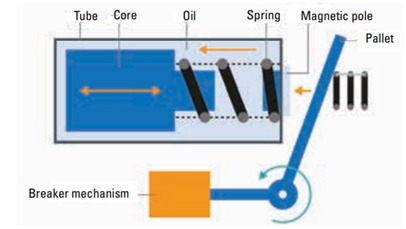
A Hydraulic Magnetic Circuit Breaker provides precise overload and fault protection using a solenoid-based mechanism. The mechanism of a Hydraulic Magnetic Circuit Breaker includes a current sensing coil paired with a set of contacts, all of which remain closed during regular operation. If an overload occurs (current exceeds the rated capacity), the series coil generates a magnetic flux, which moves a core within a fluid-filled tube, thereby tripping the beaker. The greater magnetic force pulls the core, releasing the lock and disconnecting the circuit. These beakers offer fast, reliable protection against current surges without relying on temperature-sensitive components.

Figure 1: Operating mechanism of a magnetic hydraulic circuit breaker (Source)
While thermal-magnetic circuit breakers are effective in many applications, they face significant challenges, particularly in extreme temperature conditions:
Hydraulic-magnetic circuit breakers are ideal for safeguarding sensitive equipment and maintaining efficient operations as they remain stable during high-current spikes, resist temperature variations, and offer precise overload protection.
Operators in the competitive rail industry face immense pressure to improve safety, reliability, and efficiency. Hydraulic magnetic circuit breakers provide a powerful solution by delivering dependable protection while eliminating nuisance tripping. This minimises downtime, enhances performance, and ensures safer, more reliable operations, meeting the stringent demands of modern rail systems. The key challenges include:
Hydraulic-magnetic circuit breakers effectively address these challenges. Unlike thermal-magnetic breakers, they respond only to current variations and are immune to temperature changes, ensuring reliable performance even in hot conditions.
Additionally, they prevent nuisance tripping from transient current surges -common when starting large motors—without compromising overload protection. The breaker's time delay is precisely controlled based on the overload size, providing faster responses to larger overloads where danger is higher and slower responses to smaller ones. This precision is possible because the number of wire turns in the load-sensing coil sets the device's current rating. By altering this number and the wire size, manufacturers can provide a breaker of virtually any rating within the unit's overall current capacity.

Figure 2: The mechanical arrangement of Hydraulic Magnetic devices features built-in resistance to shocks and vibrations.
The mechanical design of hydraulic-magnetic breakers (shown in Fig 2) provides excellent shock and vibration absorption, which is crucial for rail applications. The core's position is stabilised by the oil’s viscosity and two main operating springs, allowing it to maintain its rest position even under continuous shock and vibration. These breakers also excel at absorbing line current fluctuations, such as bursts and fast transients, thanks to the time delay imposed by the oil viscosity and the natural magnetic gap between the pole and armature. This gap acts as a transient energy storage sink, preventing the magnetic circuit from becoming saturated and tripping the breaker mechanism.

Figure 3: Air gaps absorb transient energy, preventing magnetic saturation during surges
Long wiring runs, a common issue in rail environments, can cause problems for some breakers. Wires crossing, overlapping, or splitting across different looms can lead to loop surfaces acting as antennae, potentially affecting the breaker and causing nuisance tripping. However, hydraulic-magnetic breakers avoid this by having a large air gap in their magnetic circuit, ensuring that reluctance is not influenced by these factors, regardless of the load current.
Unlike thermomagnetic devices, hydraulic-magnetic breakers can carry their full rated current without temperature derating. This is particularly beneficial in rail applications, where high impedance values often limit short-circuit currents. Designers can take advantage of this limitation and specify breakers not oversized for any short-circuit current they would encounter in practice.
Figure 4: A sudden sharp in triggering time occurs at the start of the magnetic region
Hydraulic-magnetic breakers are also highly effective in compensating for the elevated ambient temperatures often found on trains. As temperatures rise, equipment becomes more susceptible to transient damage and needs faster protection. The hydraulic-magnetic devices achieve this by reducing the oil viscosity, allowing the core to move more quickly to break the circuit. While the response time accelerates, the tripping current level remains unaffected, ensuring faster protection without causing nuisance tripping.
In addition to their functional benefits, hydraulic-magnetic breakers offer physical advantages. Their compact design allows for front-face mounting, leaving the back plate free to accommodate power terminals and auxiliary switches. This simplifies cable management and enables tighter spacing between adjacent breaker lines. The electrical terminals, often implemented as studs, provide safe, reliable closed lug connections aligned with rail standards.
Hydraulic-magnetic circuit breakers offer precise, reliable, and cost-effective solutions to most design challenges. These breakers are considered temperature stable, and their overcurrent sensing mechanism reacts only to changes in current in the circuit being protected. They are available with multiple configuration options, and many offer advanced features and cutting-edge designs to meet today’s leading application requirements. As a global distributor, Farnell offers a wide variety of circuit breakers to combat different requirements and ensure high performance across multiple industries.